
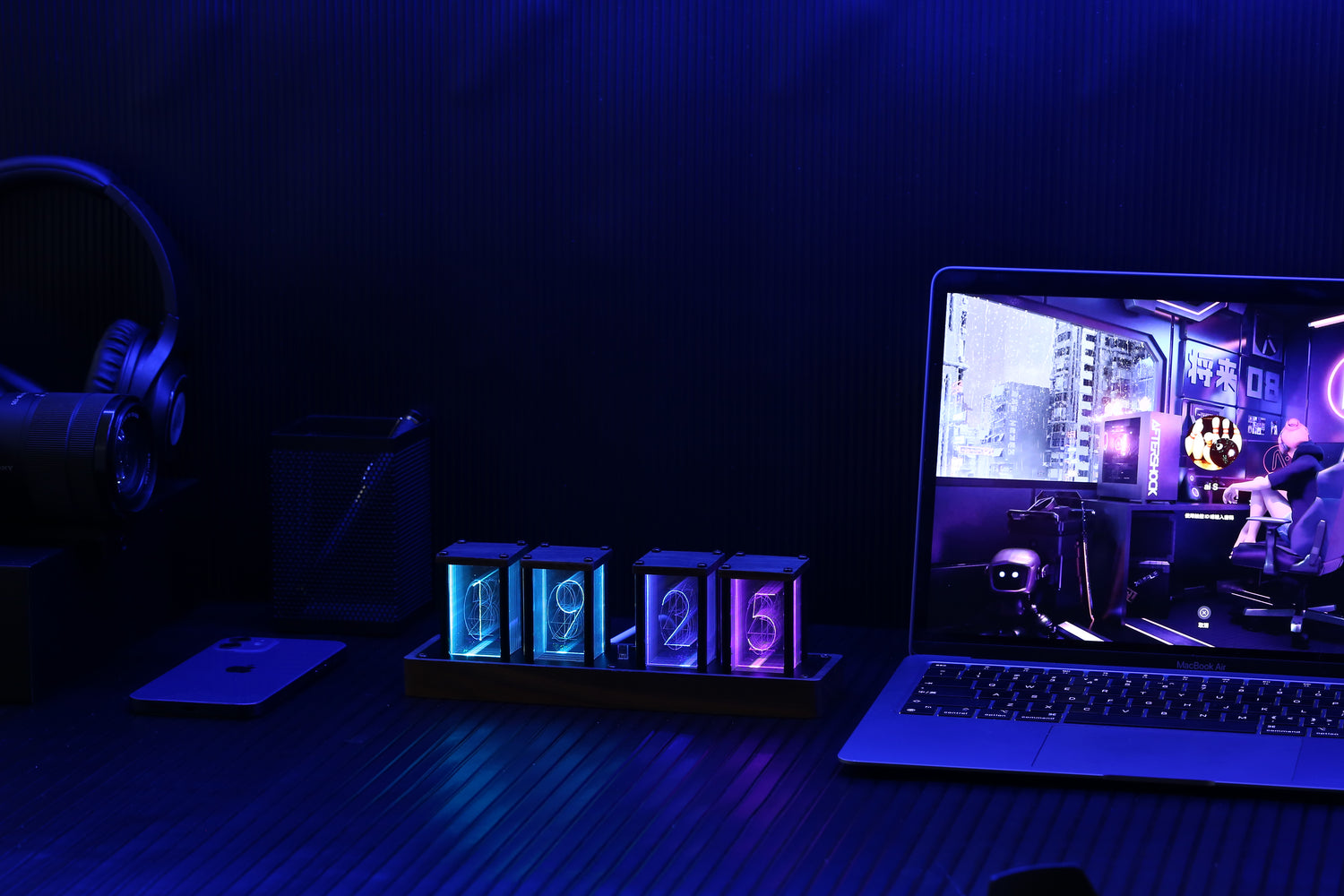
A Nixie-style clock recreates the layered, glowing-number look associated with vintage Nixie tubes while using modern display materials and controls. The result is a desk clock with a retro-futuristic silhouette, adjustable color, and familiar digital functions—without pretending to be an original gas-discharge Nixie clock.
ClocTeck’s current RGB tube clock collection uses illuminated, engraved number panes arranged in transparent display positions. This guide explains what that means, how it differs from a real Nixie tube, and which design is likely to suit your desk.
What is a real Nixie tube?
A traditional Nixie tube is a glass, gas-filled display component containing separate metal cathodes shaped like numerals. When the appropriate cathode is energized, the selected number glows. Original Nixie displays are admired for their warm light, physical depth, and unmistakable industrial character.
That character comes with tradeoffs. Authentic tubes are now specialist components, require dedicated high-voltage drive electronics, and can be more expensive or delicate to replace. A real Nixie clock is therefore best viewed as a collector’s electronic object rather than the only way to create a layered illuminated display.
How does a ClocTeck Nixie-style clock work?
Instead of gas-filled tubes, a ClocTeck RGB tube clock uses multiple transparent panes engraved with the digits 0–9. RGB LEDs illuminate the correct pane for each display position. Because the numerals occupy separate physical layers, the display keeps much of the dimensional look people associate with Nixie tubes.
The clock is powered through USB-C and adds practical controls for brightness, color, alarm, timer, 12/24-hour display, and Wi-Fi time synchronization. The RGB tube clock manual covers the shared setup workflow for the 4-, 5-, and 6-position models.
LED Nixie-style clock vs. real Nixie clock
| Feature | ClocTeck Nixie-style clock | Traditional Nixie clock |
|---|---|---|
| Display method | RGB LEDs illuminate engraved transparent digit panes | Gas discharge illuminates numeral-shaped metal cathodes |
| Color | Selectable RGB colors and animated modes | Usually a characteristic orange glow |
| Power and control | USB-C power with digital controls and Wi-Fi setup | Dedicated high-voltage driver circuitry; features vary by maker |
| Daily functions | Brightness, alarm, timer, 12/24-hour display, and time sync | Depends on the individual clock design |
| Best suited to | Everyday desks, bedrooms, gaming rooms, and gifts | Collectors and enthusiasts who specifically want original tube technology |
Why choose the modern interpretation?
More control over the visual mood
A real Nixie tube has a signature color. An RGB interpretation gives you more freedom: warm amber for a restrained retro look, cool blue beside a workstation, or a multicolor mode for a gaming room. Adjustable brightness also helps the display fit different times of day.
Useful as a clock, not only as an object
The visual design may attract attention first, but daily usability matters. ClocTeck models support an alarm, a countdown timer, 12/24-hour selection, and Wi-Fi-assisted time synchronization. The controls are shared across the core tube-clock range, so choosing a size does not mean relearning the product.
A clearer entry point to the aesthetic
If you like the look of layered digits but do not need original glass tubes, an LED Nixie-style clock is a practical entry point. It delivers depth and light in an everyday format while being transparent about the technology used.
How to read Nixie clock product descriptions honestly
“Nixie,” “Nixie-style,” and “Nixie tube simulation” are sometimes used interchangeably in online listings, but they do not describe the same technology. A listing for a traditional Nixie clock should identify the tube type and the electronic driver. A modern interpretation will normally identify LEDs, acrylic or glass-look digit panes, and low-voltage power.
Look closely at the product photographs as well. In an engraved-pane display, inactive numerals remain visible as physical layers behind the illuminated digit. That depth is an intentional part of the design. It is not a defect and it is also not a hidden claim that the product contains original gas-discharge tubes.
ClocTeck describes these products as RGB Nixie-style clocks because the wording communicates both sides of the product: the historical visual reference and the modern display method. Clear terminology helps buyers choose for the right reason and reduces disappointment after delivery.
How the clock fits a desk setup
A tube clock works best when it has enough surrounding space for the individual modules to read clearly. On a compact desk, place it beside rather than directly in front of a monitor stand. On a wider workstation, centering it under a display can create a calm horizontal anchor.
Color restraint usually produces the most durable setup. Warm amber complements walnut and darker metals; cooler single colors can connect the clock to a keyboard or computer lighting scheme. Animated rainbow modes are useful when you want an obvious focal point, but a static or slowly changing color is easier to live with during work.
In a bedroom, brightness matters more than maximum visual impact. Test the lowest setting, keep the display out of the direct line of sight from the pillow, and use a stable surface where the cable cannot be pulled. In a living room or studio, a larger model can be viewed from farther away and treated more like an illuminated design object.
What should you check before buying?
- Available width: measure the space between your monitor, speakers, charging stand, and other desk objects.
- Information at a glance: decide whether a compact hours-and-minutes display is enough or whether you prefer a larger six-position layout.
- Night use: choose a position where the display will not shine directly toward your eyes, and lower brightness before sleep.
- Power: use a stable 5V/1A supply and a suitable USB-C cable.
- Wi-Fi setup: the connection is used for configuration and time synchronization; follow the manual for your network environment.
Which ClocTeck tube clock should you choose?
The 4-tube clock is the most compact option for a smaller desk or bedside surface. The 5-tube clock gives the transparent modules more visual presence without taking the full width of the largest model. The 6-tube clock is the widest design and suits users who want a full, prominent display.
For dimensions, pricing, and use-case comparisons, continue with our 4-, 5-, and 6-tube buying guide or browse all ClocTeck desk clocks.
Frequently asked questions
Is a ClocTeck RGB tube clock a real Nixie clock?
No. It is a Nixie-style LED clock that uses illuminated engraved panes rather than gas-filled Nixie tubes. We use “Nixie-style” to describe the visual influence, not the underlying display technology.
Can each display position use a different color?
The tube-clock controls include custom color selection and several animated display modes. Exact steps are listed in the online manual.
Does the clock need a permanent internet connection?
Wi-Fi is used for setup and time synchronization. Core display controls can also be accessed from the clock’s buttons. Network behavior can vary by firmware, so use the current manual when configuring the device.
Explore the collection: compare the 4-tube, 5-tube, and 6-tube ClocTeck RGB clocks.


Hinterlasse einen Kommentar
Alle Kommentare werden vor der Veröffentlichung geprüft.
Diese Website ist durch hCaptcha geschützt und es gelten die allgemeinen Geschäftsbedingungen und Datenschutzbestimmungen von hCaptcha.